Inventory
$1,100,000
1937 Peugeot
302 DS Darl'mat Sport
Premier Art Deco classic with exceptional provenance from prominent private collection. Factory Le Mans team car, believed to be class winner and 7th OA at Le Mans in 1937, a fully show restoration, as exhbited at Pebble Beach. One of the most beautiful racing cars of the thirties.
- VIN705501
- Exterior ColorBlue
- Interior ColorBurgundy
- Mileage16717 Kilometers (TMU)
- Engine1991cc inline 4-cylinder
- Transmission4-speed manual
- StatusInventory
- StockFJ3112
Description
1937 Peugeot 302 DS Darl’mat Sport
Coachwork by Pourtout
Chassis Number 705.501
Dark Blue with Burgundy Leather Interior
One of the most inspiring and captivating art and design movements of the 20th century was captured in the Art Deco era. Unlike other movements, Art Deco influenced fashion, graphics, furniture, architecture, and automobiles. Nowhere was this more evident than in Europe, particularly in France where the earlier Art Nouveau movement blended artistry and industry, laying the foundation for the fluidity, form, and modernism that would culminate in Art Deco. Perfectly poised in the booming 1920s, Art Deco seized upon rapidly growing new wealth and scalable production technologies to bring about some of the most dramatic and memorable artifacts of the 20th century.
Peugeot, officially recognized as the oldest automobile manufacturer in the world, began more than 200 years ago as a family business manufacturing various tools, bladed instruments, grinders, and bicycles. By the late 1800s, Armand Peugeot had become enchanted by emerging automobile technology. Eager to produce a car of their own, Peugeot licensed Daimler engines to build its first automobile. Production continued into the early 1900s incorporating innovative technologies, eventually developing their own engines while becoming pioneers of automobile racing, including participation at the Indianapolis 500 races in the 1920s. Although the first world war slowed progress, Peugeot continued into the 1920s amassing Grand Prix wins while growing their production capacity for volume manufacturing.
Emile Darl’mat, an established Peugeot distributor in Paris, who specialized in offering modified sporting designs and improved engines for their cars, approached Peugeot in 1936 with the concept of a racing partnership involving the successful Peugeot 302. Though a saloon platform, Darl’mat conceived of a sports car powered by the more powerful 402 series 2.0 liter engine together with the larger 402 front and rear axles. The approved project began with Peugeot providing the modified chassis and commissioning the renowned Parisian coachbuilder Marcel Pourtout of Carrossier Pourtout who engaged in-house designer Georges Paulin, later to become one of the most celebrated designers of the century, for the final design. Because of their Parisian location and entirely French staff, Paulin was highly influenced by both Art Deco motifs and industrial streamlining. A prototype low slung roadsters was built with no doors, a low profile windscreen, and distinct racing character, far more daring than what Darl’mat had previously offered to its customers. Its performance at the Montlhéry racing circuit in 1936 demonstrated that Darl’mat was moving in the right direction. The first series of 12 roadsters, based on the enhanced prototype design, was launched for selected customers.
Although Pourtout and Paulin developed two available body styles in this period (coupé and roadster, with the cabriolet arriving later), Darl’mat had bigger goals for the roadster; the team was aiming for the most impressive proving ground of the times – Le Mans. To get there, Darl’mat needed to finance the Le Mans effort using his own resources. Typical for the times, the first cars made were sold to finance costly racing efforts which, upon inviting racing successes, would justify the expense by boosting sales of customers' cars.
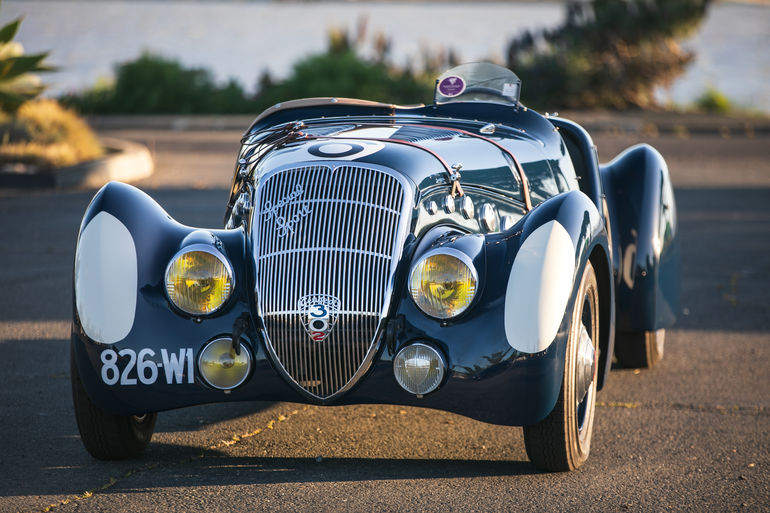
1937 would prove to be an historic year. In 1936, Gran Prix racing was dominated by German entrants Mercedes-Benz and Auto Union. French pride was at stake, particularly given the war years. The project demanded the best from all assembled, especially in the drivetrain. Uprated by the factory, each 2-liter engine featured dual carburetors, larger oil sump capacity, and more robust capacity radiators. Each car was also fitted with a concealed spare tire, twin fuel fillers, road lamps, and finished with distinct front fender livery to distinguish each car during competition when viewed from the front. With caution and good fortune on their side, all three cars finished, with the first two cars completing 203 laps at an average of 71 mph, most notably with the first of the three cars finishing 2nd in class, and 7th overall. The second car finished 8th, and car #27 finished in 10th place.
This Darl’mat, chassis number 705.501, was very likely the first example of the initial 12 roadsters constructed in the series that included the three Le Mans roadsters for entrance to the 1937 24 Hours of Le Mans race. Although 705.501 was constructed prior to the 1937 Le Mans race, and it has been previously credited as one of the three cars raced at Le Mans, there are no currently available records attributing 705.501 to period competition and no definitive Le Mans or Peugeot records that correlate chassis numbers with the three 1937 Le Mans cars. However, 705.501, the first series car, has unique features distinctly recognized by renowned Peugeot Darl’mat historian Lionel Perrette (members of Les amis de Darl’mat) as very likely the first example of the Darl’mat roadster; becoming a key vehicle in the design and engineering of the subsequent Le Mans cars. 705.501 is recognized without question as the seminal artifact of the Darl’mat lineage deriving the iconic Art Deco design while fostering the forthcoming success achieved by the 1937 Le Mans entrants.
Remarkably, and very likely attributed to the protected private ownership of 705.501, it remained in largely preserved original condition and undamaged for decades. The well documented history spanning initial build and sale to the first owner is chronicled in numerous reference documents gathered from multiple sources. 705.501 begins with the chassis manufactured by Peugeot Sochaux and delivered on February 26, 1937. Pourtout coachwork followed, completed in April 1937 (probably commission 1429 on Pourtout records) and subsequently delivered to customer/car dealer on April 20, 1937 (probably M. Fulcanio) and registered on the same day.
The first recorded appearance of the chassis number is found in Paris, August 1939, then with the registration 4849 RM7 on December 22, 1954, and then acquired by Garage SAUSSURE in the Vosges region and registered as 938 BC 88 April 4, 1962, naming Joseph BOISSON (same registration), a mechanic in Claudon (88410) in the Vosges region. Registration is followed by the next owner, Jacques Schwindenhammer, Turckheim (68230) in the Alsace region. In 1967, public records indicate 705.501 was offered for sale as part of the well-known private automobile collection held by Industrialist Jacques Schwindenhammer. In 1968, 705.501 was then sold to Jacques Lefranc, founder of Musee d’Automobiles du Forez in Sury Le Comtal (42450). Lefranc sold the car on May 20, 1976, to Michel Breistroff, a dental surgeon in Belleville sur Saone (69220) near Lyon. Breistroff registered the car with the license plate 509 GB 69, later transferring the car to Jaques Luri. By 1980, 705.501 was purchased by Adrien Maeght who recommissioned the car mechanically, keeping it largely original, other than refinishing it with a new coat of paint. By 2013 the car would find ownership in the UK with a private owner who subsequently exchanged it in a trade involving a Gran Prix Bugatti. In 2019 the car was acquired by the current owner, a dedicated vintage automotive enthusiast, who commissioned a comprehensive cost-no-object restoration performed by marque experts including restorative coachwork performed by the award winning craftsmen at Moal Coachbuilders, paint provided by Ryan Pimentel, Pimentel Innovations, mechanical restoration performed by Burlingame Motors, and reupholstery performed by Acker Leather Works. The team and patron worked tirelessly to ensure that all services, restoration, and construction of specialized components were performed to the highest standards of workmanship and authenticity.
After the restoration was completed, 705.501 was shown at the prestigious 2023 Concorso d’Eleganza Villa d’Este, received the Chairman's Award at the 2023 Hampton Court Palace Concours d’Elegance, was shown at the 2024 Pebble Beach Concours d’Elegance, and received the Car and Driver “Ceppos 2024 Best of Show” award from writer and Director, Rich Ceppos.
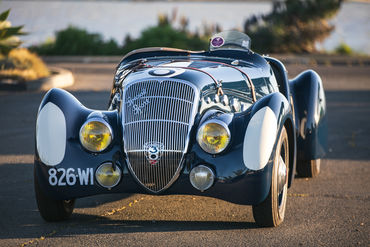
Today this historically important and beautifully restored Darl’mat conveys commanding presence, exemplary restoration, and mechanical excellence throughout. Recognized as the first of this series, an important detail conveys the unique nature of this earliest iteration; the upswept arrow line at the termination of the body to hood line at the grille, on both sides of the car (later series and Le Mans cars have the downswept arrow line at the grille terminus). As the earliest example, 705.501 embodies the essence of the pure doorless roadster design conveying the beautiful Georges Paulin design and Pourtout coachwork. Cloaked with unified flowing body and fender lines, Art Deco trim, dramatically arched fenders, a tapered and streamlined trunk, and a perfectly trimmed roadster coachline, the elegant dark blue finish accentuates the alloy coachwork forms with gorgeous reflection lines, particularly impressive given the dark color and complex curvatures. The superb bodylines are accented by beautiful trim, reflective of the design excellence of the period. The covered rear fender line is perfectly suited to the streamlined era which overlapped Art Deco and the convergence of aircraft technology. As a final touch, a pair of polished aluminum fuel fillers complete the competition theme. Minimal chrome trim, lighting, and various other polished elements glisten as wonderfully jeweled elements thoughtfully enhancing the purposeful roadster design.
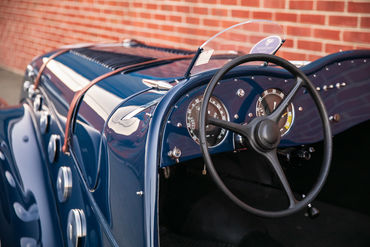
The interior is fitted with oxblood leather seats mounted over fluted rubber flooring and trimmed in black. The competition themed artistry continues with beautifully finished large dial Jaeger gauges, a commanding three-spoke large diameter black steering wheel, and exposed fasteners trailing the dashboard perimeter. A tan canvas tonneau cover acts as an effective air stream surface when piloting the car as a single driver, while the small profile windscreen further accentuates the low slung roadster design. A tribute to the Art Deco period, the combined simplicity of form, exquisite alloy and steel body lines, and competition themed features convey a truly remarkable statement of this era.
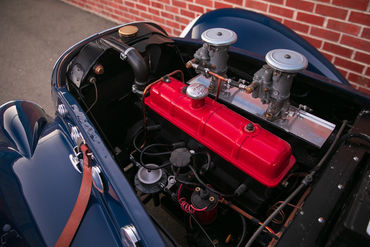
Unlatching the leather bonnet straps above the distinctive descending scale chrome discs flanking both fenders, the engine conveys the clever simplicity behind the mechanical design. The four cylinder engine is topped with twin downdraft Zenith carburetors, basic and easily serviceable mechanical features, with ready access for adjustments – a feature most drivers of these cars were handy enough to perform on their own. The engine has been restored using correct finishes, proper mechanical details, and refined craftsmanship. The engine compartment visually embodies the simplicity of the mechanical challenge, to build an effective performance car that was both durable and reliable. The trunk compartment is accessed via a removable aluminum lid housing a spare tire and provision for storage of the tire jack and tire changing tools.
This beautiful Darl’mat starts on command, offering a blend of mechanical sounds invoking the charm of this era. The engine benefits from the factory uprated dual carburetor specifications with surprisingly good acceleration attributed to the lightweight hand formed aluminum and steel body shaped over the hand hewn and joined ash frame. The electromagnetic Cotal gearbox is easily engaged, allowing this impressive automobile to pull very well especially in the higher rev range. At higher speeds, the ride is quite exhilarating and all the more remarkable considering Le Mans drivers Jean Pujol and Marcel Conte averaged 71 mph while completing 203 laps in their similarly prepared Darl’mat. Indeed, as confidence builds behind the wheel, the result is an unmistakable driving experience, one that reflects the magic of this era delivering superb performance and stunning design. 705.501 comes with a canvas wrapped jack and tire tools, a red upholstered seat accessory, and a canvas tonneau cover. Documentation accompanying the car includes a host of restoration invoices, copies of collected history, photos, and research documenting this car, the three Le Mans cars, the 1937 race, and import documentation papers for 705.501.
Exquisitely designed and historically important, this visually captivating coachbuilt alloy bodied Peugeot 302DS Darl’mat Sport is considered a pinnacle of the Art Deco period. The first car produced in this series, and the seminal father of the three 1937 Le Mans examples, this unrepeatable combination of restoration artistry, historic provenance, and coachbuilt innovation is ready to command continued attention at any of the top world-class concours, touring events, or vintage racing exhibition events.
The above vehicle information is complete and accurate to the best of our knowledge at the time it is posted to this website. Corrections or additional information is always appreciated. All advertised prices exclude government fees and taxes, any finance charges, any dealer document preparation charge, and any emission testing charge. Vehicles are subject to prior sale. All advertised to be true but not guaranteed. We assume no liability for errors or omissions.
Inquire About This Car
Fantasy Junction • 510-653-7555 • 1145 Park Ave, Emeryville, CA 94608
Similar Cars
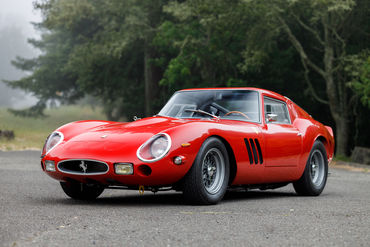
1962
$850,000
Ferrari
250 GTO Re-Creation
Re-creation built on 250GTE #3121. Stunning craftsmanship, six Weber engine, gorgeous body lines, and accurate details...